What Rising Interest Rates Mean for Las Vegas Housing Market Buyers and Sellers

As a top Realtor serving Las Vegas and Henderson, I have watched mortgage rates climb past 7.5%, reaching levels not seen since late 2023. These changes have created a housing market where understanding the numbers and having the right strategy matter more than ever.
Home values in Las Vegas remain relatively elevated, even as sales have declined 7.4% compared to the previous year. This creates an interesting situation for both buyers and sellers. Buyers are gaining negotiating power, while sellers must be more strategic about pricing and marketing their properties.
Having helped hundreds of buyers and sellers navigate the Las Vegas real estate market, I understand how changes in mortgage rates can directly affect purchasing power, property values, and overall financial decisions.
In this article, I will break down how rising interest rates are affecting the Las Vegas housing market, what buyers and sellers should consider, and what we might expect moving forward.
How Rising Rates Change the Las Vegas Housing Market
Mortgage rates are influenced by several economic factors, including inflation, Treasury yields, and Federal Reserve policies. When these factors change, they can directly affect mortgage payments, buyer affordability, and housing demand.
Why Mortgage Rates Respond to Inflation and Bond Yields
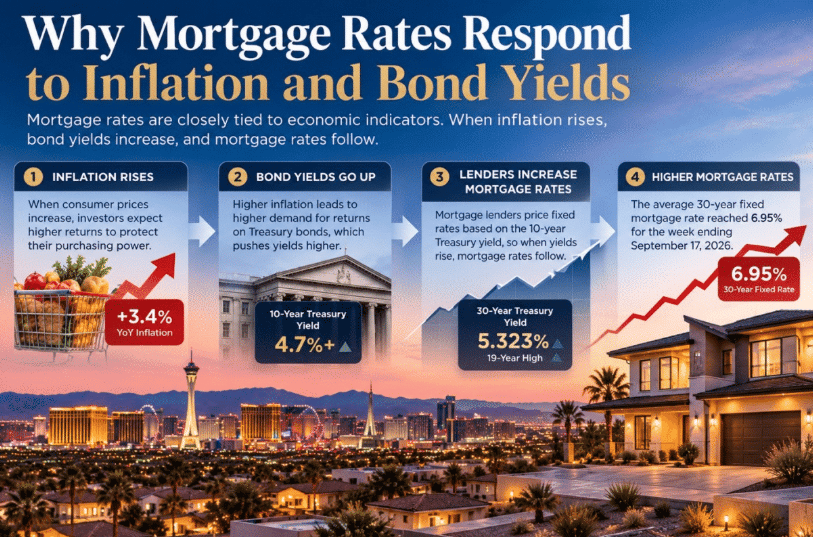
Mortgage lenders closely monitor the 10 year Treasury yield when determining interest rates for fixed mortgages. When inflation increases, investors typically demand higher yields to compensate for the declining purchasing power of their investments.
When consumer prices increased 3.4% compared to the previous year, exceeding the Federal Reserve's 2% inflation target, Treasury yields responded accordingly.
The 10 year Treasury yield climbed above 4.7%, while the 30 year Treasury reached 5.323%, its highest level in 19 years.
By the week ending September 17, 2026, the average 30 year fixed mortgage rate had reached 6.95%, compared to 6.76% the previous week and 6.26% one year earlier.
These changes have a direct impact on the Las Vegas housing market. Higher borrowing costs reduce purchasing power, influence buyer demand, and require sellers to reconsider their pricing strategies.
How Higher Rates Slow Home Sales
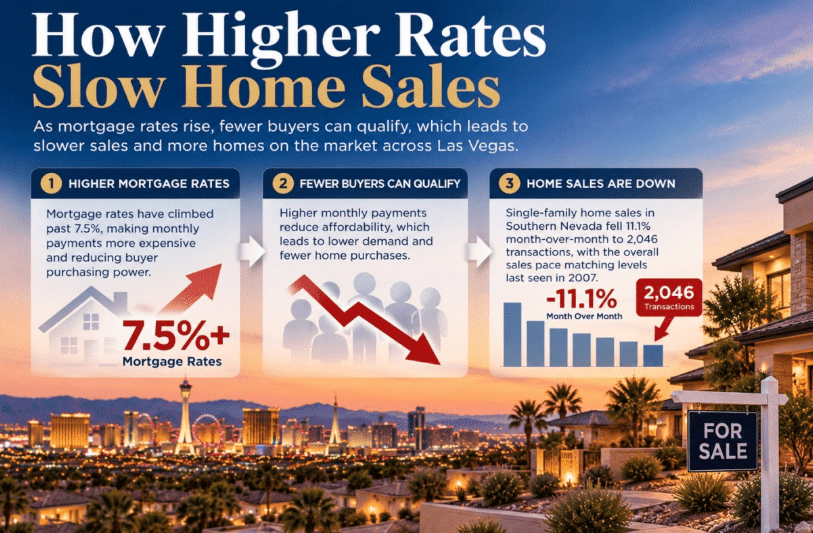
Higher mortgage rates generally lead to fewer home sales because buyers must qualify for larger monthly payments.
In Southern Nevada, single-family home sales declined 11.1% compared to the previous month, reaching approximately 2,046 transactions. Overall sales activity has slowed to levels comparable to those experienced in 2007.
At the same time, available housing inventory has increased to approximately four to nearly five months of supply, compared to around three months a year earlier.
This shift is creating more opportunities for buyers, especially those who are financially prepared and understand how to negotiate effectively.
For sellers, it means that pricing, presentation, and marketing are becoming increasingly important.
Why Homeowners With Lower Mortgage Rates Hesitate to Sell
Many homeowners purchased or refinanced their properties when mortgage rates were near 4% or lower.
Selling their current home and purchasing another property with a mortgage rate closer to 7% could significantly increase their monthly housing expenses.
As a result, many homeowners are choosing to remain in their current properties rather than move.
According to a Bankrate survey, 54% of homeowners indicated they would not feel comfortable selling at any mortgage rate in 2025, while only 3% would consider selling with rates at 6% or higher.
Economists estimate that this mortgage rate lock-in effect prevented approximately 1.33 million home sales nationwide.
For homeowners with mortgage rates below 4%, maintaining their existing loans has resulted in average monthly savings of approximately $511.
This situation creates an unusual housing market where some potential sellers are reluctant to list their homes, even as higher borrowing costs reduce demand from buyers.
What Rising Inventory Means for Las Vegas Home Values
As more homes become available and fewer buyers enter the market, sellers face additional competition.
The median listing price in Las Vegas is approximately $460,000, representing a 3.18% decline compared to the previous year.
Homes are spending a median of 59 days on the market, while Zillow estimates the average home value at approximately $417,475, reflecting a 2.8% annual decline.
Approximately 43% of active listings have experienced at least one price reduction, with the median reduction reaching $18,900.
Meanwhile, available single-family home inventory has increased from approximately 8,100 to 8,400 properties.
While these numbers indicate a cooling housing market, they do not necessarily suggest a housing crash.
Instead, they reflect a market adjustment where pricing and negotiation strategies are becoming more important for both buyers and sellers.
What Higher Mortgage Rates Mean for Las Vegas Buyers
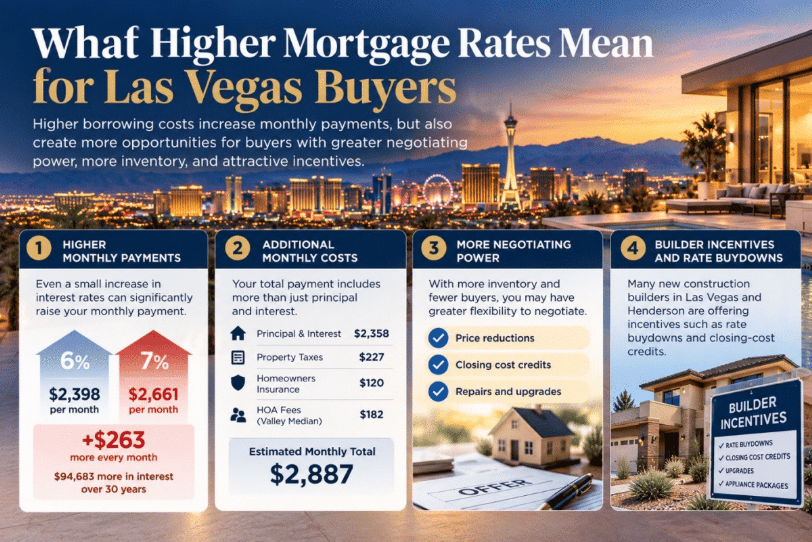
Although higher interest rates increase borrowing costs, they can also create opportunities for buyers who understand the current market.
With more inventory available and homes taking longer to sell, buyers may have greater flexibility when negotiating purchase prices, closing costs, repairs, and financing incentives.
Compare Monthly Mortgage Payments at Different Interest Rates
Even a small change in mortgage rates can significantly affect your monthly payment.
Consider a $400,000 mortgage with a 30 year repayment term.
At a 6% interest rate, the monthly principal and interest payment would be approximately $2,398.
At a 7% interest rate, that payment increases to approximately $2,661.
That represents an additional $263 every month and approximately $94,683 in additional interest over the life of the loan.
Before purchasing a home, I always encourage buyers to understand their complete monthly payment and determine what fits comfortably within their budget.
The goal is not simply to qualify for a mortgage. It is to purchase a home that makes financial sense for your lifestyle and long-term plans.
Budget for Property Taxes, Insurance, and HOA Fees
One mistake buyers sometimes make is focusing only on the mortgage principal and interest payment.
However, your actual monthly housing expense may also include property taxes, homeowners insurance, mortgage insurance, and HOA fees.
For example, a home in Clark County priced around $454,000 with financing at 6.76% could have the following estimated monthly expenses.
- Mortgage principal and interest: $2,358
- Property taxes: $227
- Homeowners insurance: $120
- HOA fees: $182
This brings the estimated monthly payment to approximately $2,887, before any additional mortgage insurance or other applicable expenses.
HOA fees are particularly important in communities throughout Las Vegas and Henderson, including Summerlin, Inspirada, Green Valley Ranch, and many newer developments.
Understanding these expenses upfront allows buyers to make informed decisions and avoid unexpected financial pressure after closing.
Use Available Inventory to Negotiate Better Terms
One advantage buyers have in a slower housing market is the ability to negotiate.
When homes remain on the market longer, sellers may become more flexible with pricing, closing costs, repairs, and other contract terms.
Nearly 80% of properties sold at or below their asking prices in July 2025, while approximately 63% of buyers successfully negotiated a price reduction.
Depending on the property and market conditions, buyers may be able to negotiate purchase price reductions of 1% to 5%, along with additional closing cost or repair credits.
However, every property is different.
A home that is priced correctly and located in a desirable neighborhood may still attract multiple offers.
When representing buyers, I carefully review comparable sales, current inventory, and the property's time on the market to determine the strongest negotiating strategy.
Sometimes the best opportunity is a lower purchase price. Other times, negotiating closing cost assistance or a mortgage rate buydown may provide greater financial benefits.
Compare Seller Paid Mortgage Rate Buydowns With Builder Incentives
New construction builders throughout Las Vegas and Henderson are offering incentives to attract buyers.
These incentives may include closing cost assistance, mortgage rate buydowns, appliance packages, or additional upgrades.
As of March 2026, approximately 64% of builders nationwide were offering some form of buyer incentive.
One popular option is a temporary 2 to 1 mortgage rate buydown.
With this financing structure, the buyer's interest rate is reduced by two percentage points during the first year and one percentage point during the second year. Beginning in the third year, the loan returns to its original interest rate.
For buyers considering new construction, these incentives can create meaningful savings during the initial years of homeownership.
However, it is important to compare the total purchase price, financing terms, and long-term costs before deciding whether a builder incentive is truly beneficial.
As a Las Vegas Realtor who works with both resale properties and new construction homes, I help buyers evaluate these options to determine which opportunities offer the greatest overall value.
Purchase a Home You Can Afford Without Depending on Refinancing
Many buyers are hoping mortgage rates will decline in the future.
While refinancing may become an option if interest rates decrease, it should not be the foundation of your home purchasing decision.
Fannie Mae has projected mortgage rates above 6.3% through 2026, while the Mortgage Bankers Association has forecast rates around 6.5% during the second half of the year.
Despite these projections, approximately 56% of recent buyers are counting on lower mortgage rates to improve their financial situation later.
My recommendation is to purchase a home with a monthly payment you can comfortably afford today.
If rates decrease in the future, refinancing may provide additional savings. However, refinancing also involves closing costs, and it can take several years for those savings to offset the expenses.
Buying within your budget today provides greater financial stability and flexibility regardless of where interest rates move next.
What Las Vegas Sellers Should Do as Buyer Demand Slows

Selling a home in a changing market requires a different approach than selling during a period of extremely low inventory and strong buyer competition.
Homes can still sell successfully, but sellers need to understand current buyer expectations and position their properties accordingly.
The right combination of pricing, preparation, professional marketing, and negotiation can make a significant difference in the final outcome.
Set Your Asking Price Using Recent Comparable Sales
One of the most important decisions when selling your home is determining the correct asking price.
In a changing market, relying on sales from six months or a year ago may not accurately reflect current property values.
I recommend reviewing comparable properties that have sold within the past 90 days, along with active listings and homes currently under contract.
Buyers have access to extensive market information and often compare multiple properties before submitting an offer.
When a home is priced significantly above comparable listings, it may receive fewer showings and remain on the market longer.
The first two weeks of a listing are particularly important because that is often when a property receives its greatest exposure to active buyers.
If a home is overpriced during this period, the seller may eventually need to reduce the asking price to generate renewed interest.
Pricing a property correctly from the beginning can help attract qualified buyers, reduce unnecessary time on the market, and protect the seller's negotiating position.
Compare Closing Cost Credits With a Price Reduction
Sellers sometimes assume that reducing their asking price is the best way to attract buyers.
However, offering closing cost assistance can sometimes provide greater value to a buyer without requiring a significant reduction in the purchase price.
For example, consider a $400,000 home. A $12,000 closing cost credit could help the buyer cover a substantial portion of their upfront expenses.
By comparison, reducing the purchase price by $12,000 might lower the buyer's monthly mortgage payment by approximately $64, depending on financing terms.
For buyers who are more concerned about their immediate cash requirements, closing cost assistance may be more attractive than a price reduction.
These incentives can also help sellers maintain their recorded sales prices, which may support comparable property values in the surrounding neighborhood.
Every transaction is different, but understanding how to structure concessions can help create solutions that benefit both buyers and sellers.
Prepare for Longer Selling Times and Potential Appraisal Challenges
As buyer demand slows, sellers should prepare for the possibility that their homes may take longer to sell.
Recent Las Vegas housing data shows that the median listing went under contract in approximately 30 days.
However, homes remaining on the market for more than 90 days experienced median reductions of approximately $34,900 from their original asking prices.
This highlights the importance of entering the market with realistic pricing expectations.
Appraisals can also become more challenging when property values are changing.
Some estimates suggest that approximately 10% to 20% of appraisals may come in below the agreed purchase price.
When this happens, buyers and sellers may need to renegotiate the transaction or explore alternative financing arrangements.
Properly documenting property upgrades, reviewing recent comparable sales, and establishing a realistic asking price can help reduce these risks.
My goal when representing sellers is to anticipate potential challenges before they become problems and guide the transaction toward a successful closing.
Las Vegas Housing Market Forecast: What Could Change Next?
The future of the Las Vegas housing market will depend on several factors, particularly mortgage interest rates, employment growth, and population trends.
While higher borrowing costs have created challenges, Southern Nevada continues to benefit from economic activity and population growth.
These factors may help support housing demand over the longer term.
How Mortgage Rates, Job Growth, and Population Trends Could Shape Demand
Southern Nevada has experienced stronger employment growth than many other metropolitan areas.
Between June 2025 and June 2026, local employment increased approximately 2.5%, compared to national growth of 0.3%.
Private sector weekly earnings also increased 5.3%, exceeding growth rates in several comparable metropolitan areas, including Phoenix, Sacramento, and San Antonio.
Population growth is another important factor supporting the Las Vegas housing market.
Clark County's population reached approximately 2.47 million in 2025, representing an annual increase of 1.8%.
The University of Nevada, Las Vegas Center for Business and Economic Research projects continued population growth of approximately 1.6% in 2026, 1.6% in 2027, and 1.5% in 2028.
These trends suggest that Southern Nevada may continue attracting residents and businesses despite higher borrowing costs.
As more people relocate to the Las Vegas Valley, demand for housing in communities such as Henderson, Summerlin, Inspirada, Southern Highlands, and other growing neighborhoods may continue to benefit.
However, employment growth and population increases do not guarantee rising home prices. Affordability and mortgage rates will remain important factors in determining future market conditions.
Why a Slower Housing Market Does Not Necessarily Mean a Crash
Whenever housing sales decline or inventory increases, conversations about a potential housing crash often follow.
However, a slower housing market and a housing crash are not the same thing.
One important difference between today's market and the 2008 financial crisis is the amount of equity many homeowners have accumulated.
Current estimates suggest the average homeowner holds approximately $310,000 in home equity.
This provides a financial cushion that many homeowners did not have during the previous housing downturn.
Foreclosure activity also remains substantially below levels experienced during the housing crisis.
Although national housing inventory reached approximately 8.5 months of supply in August 2026, it remained below the roughly 13 months of supply seen before the previous crash.
These differences are important when evaluating the overall health of the housing market.
While property values may experience adjustments, current conditions do not automatically indicate a widespread housing collapse.
For buyers and sellers in Las Vegas, understanding the difference can help prevent emotional decisions based on headlines rather than local market fundamentals.
Final Thoughts on the Las Vegas Housing Market
Rising mortgage rates have changed the Las Vegas real estate market, but they have also created opportunities for buyers and sellers who understand how to navigate current conditions.
Buyers may benefit from increased inventory, greater negotiating flexibility, and potential financing incentives.
Sellers can still achieve strong results by pricing their homes accurately, preparing their properties properly, and using effective marketing strategies.
Although the market has slowed, continued employment growth, population increases, and homeowner equity provide important factors supporting the long-term outlook for Southern Nevada.
Whether you are purchasing your first home, upgrading to a larger property, investing in real estate, or preparing to sell, having the right strategy can make a meaningful difference.
As a Realtor specializing in Las Vegas and Henderson, I take the time to understand each client's goals, explain the available options, and develop a personalized plan designed to achieve the best possible outcome.
Real estate decisions should be based on your individual circumstances, financial goals, and the opportunities available in today's market.
Let's Connect
If you are considering buying or selling a home in Las Vegas or Henderson, I would be happy to help you navigate the current housing market.
Whether you are exploring new construction, comparing existing homes, or determining the best time to sell.
I can provide local market insights and personalized guidance to help you move forward with confidence.